

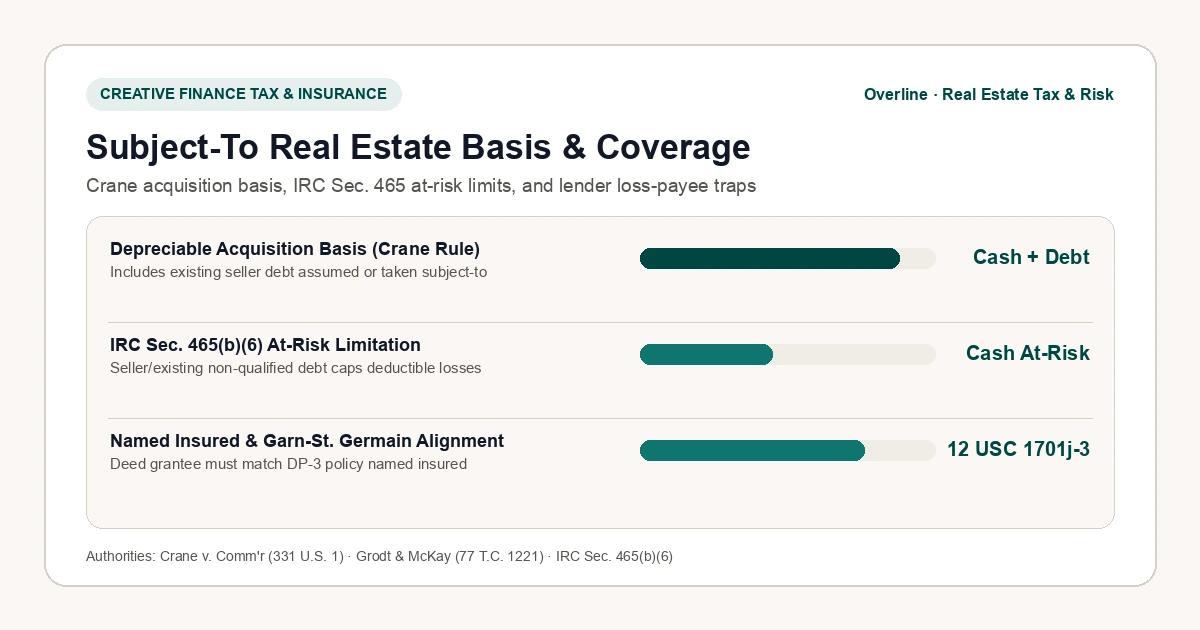
2026 Practitioner Quick Answer: In a "Subject-To" rental purchase, the buyer holding the recorded deed and bearing the benefits and burdens of ownership claims 100% of MACRS and cost segregation deductions. Under IRC Section 167, Helvering v. F. & R. Lazarus & Co., and Grodt & McKay Realty, Inc. v. Commissioner, the former seller still named on the note claims $0. Under Crane v. Commissioner, 331 U.S. 1 (1947), your depreciable cost basis includes the full unpaid mortgage balance taken subject-to plus cash paid. Deeding a property into an investor LLC is not exempt from due-on-sale acceleration under the Garn-St. Germain Act (12 U.S.C. 1701j-3(d)). Leaving the seller's HO-3 homeowner policy active also creates an insurable-interest gap that requires binding a DP-3 landlord policy (benchmark rates with Insurance AI).
| Subject-To Deal Dimension | Buyer (Recorded Deed & Equitable Owner) | Seller (Still Named on Promissory Note) | Governing Authority |
|---|---|---|---|
| MACRS & Cost Seg Depreciation | Claims 100% of building & 5/15-year depreciation | Claims $0 after transfer date | IRC Sec. 167(a), Pub. 527, Grodt & McKay (77 T.C. 1221) |
| Unadjusted Cost Basis | Cash paid + closing costs + unpaid Subject-To debt | Relieved debt counts in IRC Sec. 1001 sale proceeds | Crane v. Commissioner (331 U.S. 1), IRC Sec. 1012 |
| Mortgage Interest Deduction | Deductible on Schedule E Line 13 as equitable owner | $0 for payments funded by the buyer | Treas. Reg. 1.163-1(b) (attach explanation statement) |
| Due-on-Sale Exposure | Investor LLC / trust assignment is actionable by lender | Loan acceleration affects seller credit if unpaid | 12 U.S.C. 1701j-3(b) & (d), Fannie Mae D1-4.1-02 |
| Hazard & Liability Policy | First Named Insured on new DP-3 landlord policy | Additional Insured / Interest (liability only) | Insurable interest doctrine + ISO Standard Mortgagee Clause |
1. Who Claims Depreciation in a Subject-To Transfer?
Buyers and sellers in creative finance transactions frequently guess wrong about who owns the tax deductions once the deed records. Because the loan servicer still mails annual Form 1098 statements with the seller's Social Security Number, some sellers keep depreciating the house on Schedule E by mistake. That filing position fails an IRS examination immediately.
Federal tax depreciation follows economic substance and beneficial ownership instead of the name printed on the bank's promissory note. Under IRC Section 167(a), IRC Section 168, and IRS Publication 527, depreciation belongs exclusively to the taxpayer who suffers capital exhaustion of the building. In Helvering v. F. & R. Lazarus & Co., 308 U.S. 252 (1939), the U.S. Supreme Court ruled that depreciation follows economic burden even when title or loan papers name another party. Four decades later, Frank Lyon Co. v. United States, 435 U.S. 561 (1978) affirmed that multi-party real estate financing retains tax recognition when grounded in genuine economic obligations.
When the IRS audits a Subject-To deed, wraparound mortgage, or land contract, examiners apply the eight-factor Benefits and Burdens test from Grodt & McKay Realty, Inc. v. Commissioner, 77 T.C. 1221 (1981).
| Grodt & McKay Factor | Standard Subject-To Rental Closing | Tax Ownership Signal |
|---|---|---|
| 1. Passage of Legal Title | Seller executes and records a warranty or grant deed to buyer or buyer's LLC | Points to Buyer |
| 2. Treatment by the Parties | Purchase contract, settlement statement, and servicing agreement treat transfer as a sale | Points to Buyer |
| 3. Equity Acquisition | Buyer captures principal paydown and market appreciation above the existing note | Points to Buyer |
| 4. Present Obligations | Seller is obligated to deliver deed; buyer is contractually obligated to service payments | Points to Buyer |
| 5. Right of Possession | Buyer holds exclusive possession and leases the property to tenants | Points to Buyer |
| 6. Property Tax Liability | Buyer pays county property taxes directly or funds the servicer escrow account | Points to Buyer |
| 7. Risk of Loss or Damage | Buyer bears casualty repair costs above insurance proceeds | Points to Buyer |
| 8. Operating & Sale Profits | Buyer collects all gross rents and keeps net resale proceeds | Points to Buyer |
Once those benefits and burdens shift at closing, the seller must report a disposition (compare installment and seller-financing exit rules) and halt all depreciation. Under Treas. Reg. 1.163-1(b), the Subject-To buyer deducts the mortgage interest actually paid as equitable owner even without personal liability on the note. Because the bank's Form 1098 carries the seller's SSN, buyers report that interest on Schedule E, Part I, Line 13 ("Other interest") with a statement naming the servicer, address, and payment total.
2. Crane Basis, At-Risk Limits & Cost Segregation Eligibility
A common myth claims that paying only $25,000 in cash entry costs limits your depreciable basis to $25,000. In Crane v. Commissioner, 331 U.S. 1 (1947), the U.S. Supreme Court ruled under the predecessor to IRC Section 1012 that "property" acquired subject to an unassumed mortgage includes the full principal balance of existing debt in initial cost basis. Under Estate of Franklin v. Commissioner, 544 F.2d 1045 (9th Cir. 1976), total acquisition debt still cannot artificially exceed fair market value.
Suppose you acquire a single-family rental after January 19, 2025 by paying $30,000 cash, $5,000 in closing fees, and taking title subject to a $365,000 first mortgage. Your unadjusted cost basis is $400,000. Subtracting a 20% land allocation ($80,000) leaves $320,000 of depreciable building basis.
Quick Year-1 Depreciation & Safe Harbor Estimator
Pick a preset or adjust 2 inputs to compare Year-1 deductions instantly.
In Modern CFO Cost Segregation Planning Benchmarks (v2026.1.0, CC BY 4.0), single-family residential rentals typically reclassify 18% to 28% of building basis into 5-year and 15-year MACRS buckets. Reclassifying 24% of that $320,000 basis ($76,800) on a post-January 19, 2025 purchase from an unrelated seller qualifies for 100% bonus depreciation in 2025 and 2026 under IRC Section 168(k) and Public Law 119-21 Section 70301. By contrast, property acquired under a written binding contract entered before January 20, 2025 and placed in service in 2025 receives the 40% phase-down rate.
Before deducting that $76,800 paper loss, verify the IRC Section 465 At-Risk limitation on Form 6198. Cash invested ($35,000) is always at-risk. Unassumed Subject-To debt counts as Qualified Nonrecourse Financing under IRC Section 465(b)(6) only when borrowed from a "qualified person" in commercial lending (such as a bank or agency lender). Disqualifying seller-financed wrap taint under Section 465(b)(6)(D)(ii) breaks that safe harbor. When a non-bank seller wraps an underlying note into a private seller-carried wraparound mortgage, Form 6198 may suspend deductions above your cash down payment until principal is paid down.
3. Garn-St. Germain Act (12 U.S.C. 1701j-3): Why Investor LLCs Are Not Exempt
Seminar promoters routinely claim that transferring a mortgaged house into a "land trust" hides or legally blocks the lender's due-on-sale clause. Federal statute says the exact opposite. Under the Garn-St. Germain Depository Institutions Act of 1982 (12 U.S.C. 1701j-3(b)), lenders hold a federally preemptive right to enforce due-on-sale acceleration clauses (typically Paragraph 18 of the uniform security instrument). That trigger applies whenever real property or any interest in it transfers without prior written lender consent.
12 U.S.C. 1701j-3(d) lists nine statutory exemptions for residential property with fewer than five dwelling units, such as transfers at death, transfers to a spouse or children, and short-term leases under (d)(4). Neither investor LLCs nor third-party trust sales qualify under those exemptions.
- Inter Vivos Trust Limit (
12 U.S.C. 1701j-3(d)(8)&12 C.F.R. 191.5): Exempts a living-trust transfer only while the original borrower "is and remains a beneficiary" and occupancy rights do not transfer. Once the seller assigns beneficial interest to an investor and vacates,(d)(8)protection vanishes. - LLC Transfers & Fannie Mae
D1-4.1-02: Business entities receive zero protection under Garn-St. Germain. Even Fannie Mae Servicing Guide Section D1-4.1-02 (for loans acquired on or after June 1, 2016) permits LLC transfers only when the original borrower retains majority ownership. Deeding a Subject-To rental into a buyer's asset protection LLC remains an actionable technical default, requiring cash reserves or a DSCR refinance backup plan.
4. Seller HO-3 vs. Buyer DP-3 Landlord Insurance & Mortgagee Clauses
Leaving the seller's existing HO-3 homeowner policy active to avoid alerting the loan servicer's escrow department is the costliest mistake in Subject-To investing. If a fire or windstorm destroys the rental after closing, the carrier's Special Investigations Unit pulls county deed records and denies the dwelling claim on two grounds.
- Lack of Insurable Interest: Property insurance indemnifies financial loss owned at the time of loss. Once the seller conveys the deed, the seller no longer owns structure equity, while the buyer LLC is a legal stranger to the seller's HO-3 contract.
- Occupancy & Rental Hazard Misrepresentation: An ISO HO-3 policy underwrites an owner-occupied residence. Converting the house into a tenant-occupied rental without rewriting coverage onto a DP-3 (Dwelling Fire Special Form) landlord policy triggers occupancy exclusions and leaves landlord liability uninsured.
To protect your equity and your tenants alongside the lender's collateral, bind a replacement DP-3 Replacement-Cost Landlord Policy at closing and benchmark rates with Overline Insurance AI.
| DP-3 Policy Role | Exact Party to List | Legal & Loss-Settlement Purpose |
|---|---|---|
| First Named Insured | Buyer (or Buyer's Title-Holding LLC) | Aligns the insurance contract with recorded deed ownership and insurable interest; controls policy endorsements and dwelling/loss-of-rents claim checks. |
| Mortgagee / Loss Payee | Existing Loan Servicer (with exact loan number) | Under the ISO Standard Mortgagee Clause, creates an independent contract protecting the lender's lien up to the unpaid balance and prevents costly lender force-placed insurance. |
| Additional Insured (Liability) | Former Seller (Original Borrower) | Extends premises-liability defense if an injured tenant sues everyone appearing in county mortgage history, without giving the seller any claim to property-damage checks. |
Yes, delivering a new DP-3 declarations page to the servicer's insurance center reveals a new Named Insured. Operators weigh manageable acceleration risk against the certainty of an unpaid $350,000 fire loss on an invalid seller HO-3 policy. Ensure Coverage A reflects full Replacement Cost Value (RCV) rather than Actual Cash Value, and review our guide on cost segregation and property insurance schedules.
Frequently Asked Questions: Subject-To Tax, Depreciation & Insurance
Q: Can both the Subject-To buyer and the original seller claim depreciation on the same house? A: No. Under IRC Section 167 and Grodt & McKay Realty, Inc. v. Commissioner (77 T.C. 1221), only the party holding beneficial tax ownership claims depreciation. Once the deed and possession transfer to the buyer, the seller must report a property sale and stop claiming Schedule E depreciation immediately.
Q: Does a Subject-To buyer get to depreciate the existing mortgage balance or only their cash down payment? A: Under Crane v. Commissioner, 331 U.S. 1 (1947), and IRC Section 1012, the buyer's initial cost basis includes both cash paid and the full unpaid principal balance of the existing mortgage taken subject-to (provided total debt does not exceed fair market value). Subtracting land value yields your depreciable building basis.
Q: How do I deduct mortgage interest in a Subject-To deal when Form 1098 has the seller's SSN? A: Under Treas. Reg. 1.163-1(b), a legal or equitable owner of real estate may deduct mortgage interest actually paid even without personal liability on the promissory note. Report the interest paid on Schedule E, Part I, Line 13 ("Other interest") and attach a statement listing the loan servicer, property address, and payment records.
Q: Does putting a Subject-To property into a land trust legally block the lender's due-on-sale clause? A: No. The Garn-St. Germain inter vivos trust exemption under 12 U.S.C. 1701j-3(d)(8) applies only while the original borrower remains a beneficiary and occupancy rights do not transfer. Assigning beneficial interest or occupancy to an investor or LLC removes statutory protection and permits lender acceleration.
Q: Should I just add my LLC as an Additional Insured on the seller's existing homeowner policy? A: No. Adding an investor LLC as an Additional Insured on a seller's owner-occupied HO-3 policy only extends narrow derivative liability coverage and does not cure the seller's lost dwelling insurable interest or tenant-occupancy exclusions. Bind a dedicated DP-3 landlord policy naming the buyer/LLC as First Named Insured, the lender under the Mortgagee Clause, and the seller as Additional Interest/Insured for liability.
Related Overline Tools & Tax Guides
- Cost Segregation & Year-1 Tax Savings Calculator
- Landlord Insurance AI & DP-3 Rate Benchmarking
- Real Estate LLC & Trust Asset Protection
- Partial Asset Disposition (PAD) Renovation Calculator
- Seller Financing & Installment Sale Tax Guide
See Your Property's Tax Savings
Drop your address. The AI estimates your depreciation savings in 60 seconds, backed by a certified engineer study.

Free cost segregation estimate, engineer-certified studies, and ongoing depreciation tracking.
Backed by $1B+ in supported tax depreciation.
Disclaimer: This article is for informational and educational purposes only and does not constitute legal, tax, accounting, or insurance advice. Subject-To transfers carry due-on-sale acceleration and state-specific creative-finance regulatory risks; consult qualified real estate legal counsel, a licensed CPA, and a commercial insurance broker before transacting.