

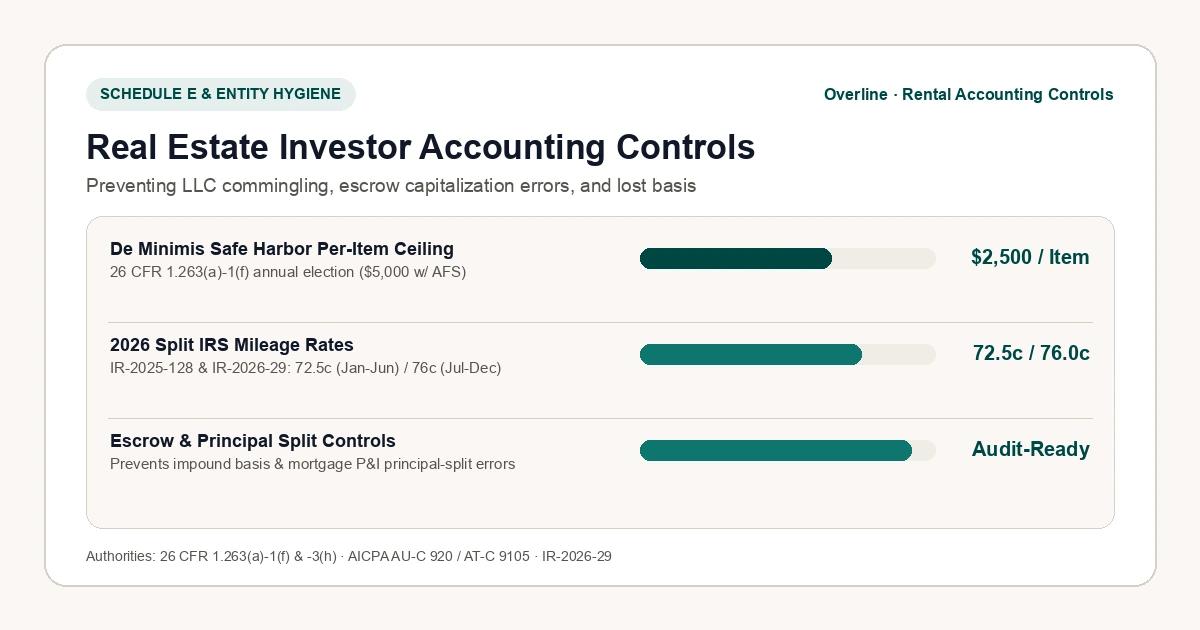
2026 Practitioner Quick Answer: Audit-ready rental accounting maps every transaction by property column onto IRS Schedule E (Form 1040), Part I, Lines 5 through 19, while separating operating repairs from BAR improvements (Treas. Reg. 1.263(a)-3). Clean ledgers also capture the 2026 De Minimis Safe Harbor ($2,500 per item without an AFS, or $5,000 with an AFS) under Treas. Reg. 1.263(a)-1(f) and Notice 2015-82. For 2026 travel, apply the split IRS business mileage rate of 72.5 cents/mile (Jan 1 - Jun 30, 2026) and 76 cents/mile (Jul 1 - Dec 31, 2026). Mixing personal and operating funds with security deposits pierces LLC asset protection and triggers IRS Bank-Deposits audits under IRC Section 6001, while clean monthly statements replace prohibited CPA comfort letters (
AICPA AU-C Section 920).
| Rental Bookkeeping Pillar | Governing Rule / Statute | 2026 Threshold or Requirement | What Sloppy Books Cost You |
|---|---|---|---|
| Schedule E Line Mapping | Form 1040 Schedule E, Part I, Lines 5-19 | Per-property tracking + Form 4562 when placed in service | Missed write-offs or 20% IRC Sec. 6662 negligence penalty |
| De Minimis Safe Harbor | Treas. Reg. 1.263(a)-1(f) & Notice 2015-82 | $2,500/item without AFS ($5,000 with AFS) in 2026 | Forced 5-to-27.5-yr depreciation on un-itemized invoices |
| Small Taxpayer Safe Harbor | Treas. Reg. 1.263(a)-3(h) | Lesser of $10,000 or 2% of building basis (<=$1M basis) | $1 overrun voids safe harbor for the entire tax year |
| 2026 Business Mileage | IRC Sec. 274(d), IR-2025-128 & IR-2026-29 | 72.5 cents/mi (Jan 1 - Jun 30, 2026); 76 cents/mi (Jul 1 - Dec 31, 2026) | Zero deduction allowed without contemporaneous mileage log |
| Anti-Commingling & Deposits | IRC Sec. 6001, DiLeo (96 T.C. 858), Indianapolis Power | Dedicated LLC operating + separate security-deposit trust account | Alter-ego veil piercing + unexplained deposits taxed as rent |
1. Exact IRS Schedule E (Form 1040) Chart of Accounts: Lines 5 Through 19
Generic small-business chart-of-accounts templates lump repairs and appliances alongside loan principal, escrow impounds, plus security deposits into messy buckets that force expensive CPA cleanup fees every March. Structuring your ledger directly around Schedule E, Part I, Lines 5 through 19 by individual property class makes year-end tax filing and lender underwriting mechanical.
| Schedule E Line | Official IRS Line Label | What Belongs Here (and Common Misclassifications to Avoid) |
|---|---|---|
| Line 5 | Advertising | Zillow/MLS listing fees, yard signs, listing photography, STR direct-booking ads. |
| Line 6 | Auto and travel | Inspection and repair trips logged under IRC Sec. 274(d). For 2026, apply 72.5 cents/mile from January 1 through June 30, 2026 (IR-2025-128) and 76 cents/mile from July 1 through December 31, 2026 (IR-2026-29), vs. 70 cents/mile in 2025. |
| Line 7 | Cleaning and maintenance | Turnover janitorial cleaning, lawn care, snow removal, pest control, HOA maintenance dues. |
| Line 8 | Commissions | Tenant-placement leasing commissions (resale broker commissions belong on Form 4797, never Line 8). |
| Line 9 | Insurance | Landlord DP-3, general liability, flood, and umbrella premiums (benchmark rates with Insurance AI). Deduct actual carrier disbursements rather than raw bank escrow transfers. |
| Line 10 | Legal and professional fees | Lease drafting, eviction counsel, bookkeeping fees, and Schedule E tax prep (Rev. Rul. 92-29). |
| Line 11 | Management fees | Property manager fees (always report full gross rent on Line 3 rather than netting 1099-MISC statements). |
| Line 12 | Mortgage interest (banks) | Form 1098 bank interest only. Principal paydown is never an expense, and refinance points amortize over the loan term. |
| Line 13 | Other interest | Private-lender notes, non-1098 entity debt, or Subject-To equitable-owner interest under Treas. Reg. 1.163-1(b). |
| Line 14 | Repairs | Incidental fixes passing the Treas. Reg. 1.263(a)-3 BAR test (pipe leaks, drywall patches, single broken windowpanes). |
| Line 15 | Supplies | Locks, air filters, bulbs, guest consumables, and itemized purchases expensed under the 2026 De Minimis Safe Harbor. |
| Line 16 | Taxes | County property taxes and occupancy taxes (exclude capital sidewalk/sewer assessments under IRC Sec. 164(c)(1)). |
| Line 17 | Utilities | Landlord-paid electric, gas, water, trash, sewer, and STR property Wi-Fi. |
| Line 18 | Depreciation or depletion | 27.5-yr / 39-yr MACRS plus 5-yr and 15-yr cost segregation deductions from Form 4562. |
| Line 19 | Other (list) | Bank ACH/wire fees, tenant screening fees, and Small Taxpayer Safe Harbor (Reg. 1.263(a)-3(h)) deductions. |
Two balance-sheet reconciliation rules prevent the most common rental Schedule E audit adjustments. First, record closing-statement tax and insurance impounds in a Prepaid Lender Escrow asset account instead of capitalizing escrow reserves into depreciable building basis. Second, split every monthly mortgage auto-draft into Line 12 interest and Prepaid Escrow funding plus Mortgage Note Principal reduction so loan principal never inflates rental expenses.
2. Tangible Property Regulations: BAR Test & Three Safe Harbors
Under Treas. Reg. 1.263(a)-3(d), any spend creating a Betterment, Adaptation, or Restoration (the BAR test) to the structure or any of the eight IRS building systems cannot be expensed on Line 14. Instead, capitalize the improvement and claim a Partial Asset Disposition write-off (Treas. Reg. 1.168(i)-8) on the demolished old component in the same tax year. Qualifying 5-year and 15-year additions acquired and placed in service after January 19, 2025 take 100% bonus depreciation in 2025 and 2026 under IRC Section 168(k) and P.L. 119-21 sec. 70301 (vs. 40% for pre-January 20, 2025 contracts placed in service in 2025).
Clean itemized invoices also unlock three high-value regulatory safe harbors (full BAR guide here).
- Under the De Minimis Safe Harbor (
Treas. Reg. 1.263(a)-1(f)andIRS Notice 2015-82), taxpayers without an applicable financial statement (AFS) may expense up to $2,500 per invoice or itemized line item ($5,000 with an audited AFS). Attach the annualSection 1.263(a)-1(f)election statement to include same-invoice delivery and installation. - Under the Safe Harbor for Small Taxpayers (
Treas. Reg. 1.263(a)-3(h)), investors with 3-year average gross receipts of $10,000,000 or less may deduct work on buildings with unadjusted basis of $1,000,000 or less. Total annual building spend cannot exceed the lesser of $10,000 or 2% of unadjusted building basis, and De Minimis items count toward that annual cliff. - Under the Routine Maintenance Safe Harbor (
Treas. Reg. 1.263(a)-3(i)), recurring upkeep reasonably expected more than once during a 10-year period (such as hallway repainting or chiller servicing) is deductible immediately with no dollar cap.
3. Commingling Risks: Veil Piercing, Bank-Deposits Audits & Security Deposits
Swiping a personal credit card for rehab materials or collecting tenant Zelle rent in a personal checking account triggers three compounding legal and tax hazards.
- LLC Alter-Ego Veil Piercing: Plaintiff attorneys subpoena bank statements first in any tenant habitability or injury suit. Routine personal transfers without documented member distributions establish "unity of interest" and help courts pierce your real estate LLC structure.
- IRS Bank-Deposits Reconstruction (
IRC Section 6001& DiLeo): Under IRC Section 6001 and Treas. Reg. 1.6001-1, taxpayers must keep permanent records substantiating gross income and deductions. When commingled accounts make records unreliable, IRC Section 446(b) authorizes the IRS Bank-Deposits Method (DiLeo v. Commissioner, 96 T.C. 858 (1991); Clayton v. Commissioner, 102 T.C. 632 (1994)). The examiner sums every deposit across personal and business accounts and taxes unexplained transfers or reimbursements unless proven non-taxable. - Security Deposit Trust Segregation (Indianapolis Power): Under Commissioner v. Indianapolis Power & Light Co., 493 U.S. 203 (1990), refundable tenant security deposits are balance-sheet liabilities rather than taxable rent upon receipt. Non-refundable fees or last month's rent remain taxable immediately under
Treas. Reg. 1.61-8(b). Commingling refundable deposits into operating checking invites audit misclassification and violates state escrow statutes in NY, MA, FL, IL, NJ, plus CT.
Maintain a three-account standard per entity: Dedicated LLC Operating Checking plus separate Security-Deposit Escrow and CapEx Reserve accounts.
4. Lender "CPA Comfort Letters": Why CPAs Refuse & How Clean Books Close Loans
Days before closing a DSCR or rental loan, underwriters often ask self-employed borrowers for a "CPA comfort letter" on a $120,000 LLC down-payment draw. Every properly licensed CPA declines solvency wording because signing it violates four professional and federal mandates.
| Governing Standard / Statute | Exact Restriction on Licensed CPAs | Safe Underwriting Alternative |
|---|---|---|
AICPA AU-C Section 920 (Letters for Underwriters) | Restricts formal CPA "comfort letters" strictly to registered or exempt securities offerings for investment underwriters; completely prohibited for consumer or commercial mortgage loans. | Provide IRS Form 4506-C transcripts plus reconciled monthly LLC P&L and Balance Sheet reports. |
AICPA AT-C Section 9105 (Interpretation No. 1, Solvency) | Expressly forbids CPAs from issuing any assurance on solvency, debt-service capacity, or whether a capital draw will impair future operations. | Supply 2 to 3 months of uncommingled LLC bank statements + LLC Operating Agreement showing 100% distribution authority. |
AICPA ET Section 1.130 (Preparing & Reporting Information) | Bars CPAs from subordinating judgment or misrepresenting unaudited taxpayer-supplied tax figures as verified financial assurance. | Request a factual tax-return preparation verification letter confirming only which returns were prepared and disclaiming audit assurance. |
IRC Section 7216 & Reg. 301.7216-3 | Imposes federal criminal and civil penalties if a tax preparer discloses or confirms any tax return data to a lender without a prior, signed, dated Section 7216 written taxpayer consent. | Sign a formal IRC Section 7216 consent before asking your CPA to send factual preparation confirmation to your loan officer. |
Need Help Implementing These Strategies?
Tax strategies only save money if your financials are clean enough to support them. Level's CFO team handles the books, cash flow, and financial oversight for service businesses and contractors, so every deduction is documented and nothing falls through the cracks at tax time.
Fractional CFO services for service businesses
Frequently Asked Questions: Real Estate Bookkeeping, Schedule E & Commingling
Q: What is the IRS business mileage rate for rental property landlords in 2026?
A: For 2026, the IRS business mileage rate splits mid-year: 72.5 cents per mile from January 1 through June 30, 2026 (IR-2025-128) and 76 cents per mile from July 1 through December 31, 2026 (IR-2026-29). Under IRC Section 274(d), keep a contemporaneous log of date, miles, property destination, plus rental purpose.
Q: Can I deduct $2,500 appliances on Schedule E instead of depreciating them over 5 years?
A: Yes, if you attach the annual De Minimis Safe Harbor election under Treas. Reg. 1.263(a)-1(f) and IRS Notice 2015-82. Taxpayers without an AFS can immediately expense itemized tangible property up to $2,500 per invoice or line item ($5,000 with an audited AFS), including same-invoice delivery and installation.
Q: Are tenant security deposits reported as rental income on Schedule E Line 3 when received?
A: No. Under Commissioner v. Indianapolis Power & Light Co., 493 U.S. 203 (1990), refundable security deposits held under a lease return obligation are balance-sheet liabilities, not gross income, until forfeited or applied to unpaid rent. Non-refundable move-in fees and advance last-month rent are taxable when received.
Q: Why won't my CPA sign my mortgage lender's comfort letter for my rental down payment?
A: AICPA AU-C Section 920 limits comfort letters to securities offerings, AT-C Section 9105 bars solvency assurance, and ET Section 1.130 bars vouching for unaudited data. With a signed IRC Section 7216 consent, your CPA can confirm prepared returns while clean LLC statements clear underwriting.
Related Overline Tools & Tax Guides
- Real Estate LLC & Trust Asset Protection
- Landlord Insurance AI & DP-3 Rate Benchmarking
- Cost Segregation & Form 4562 Tax Savings Calculator
- Partial Asset Disposition (PAD) Renovation Calculator
- De Minimis Safe Harbor Election (2026 Guide)
See Your Property's Tax Savings
Drop your address. The AI estimates your depreciation savings in 60 seconds, backed by a certified engineer study.

Free cost segregation estimate, engineer-certified studies, and ongoing depreciation tracking.
Backed by $1B+ in supported tax depreciation.
Disclaimer: This article is for informational and educational purposes only and does not constitute tax, legal, or accounting advice. Consult a licensed CPA and real estate attorney regarding your Schedule E classifications, state security-deposit trust rules, and annual safe-harbor election statements.