

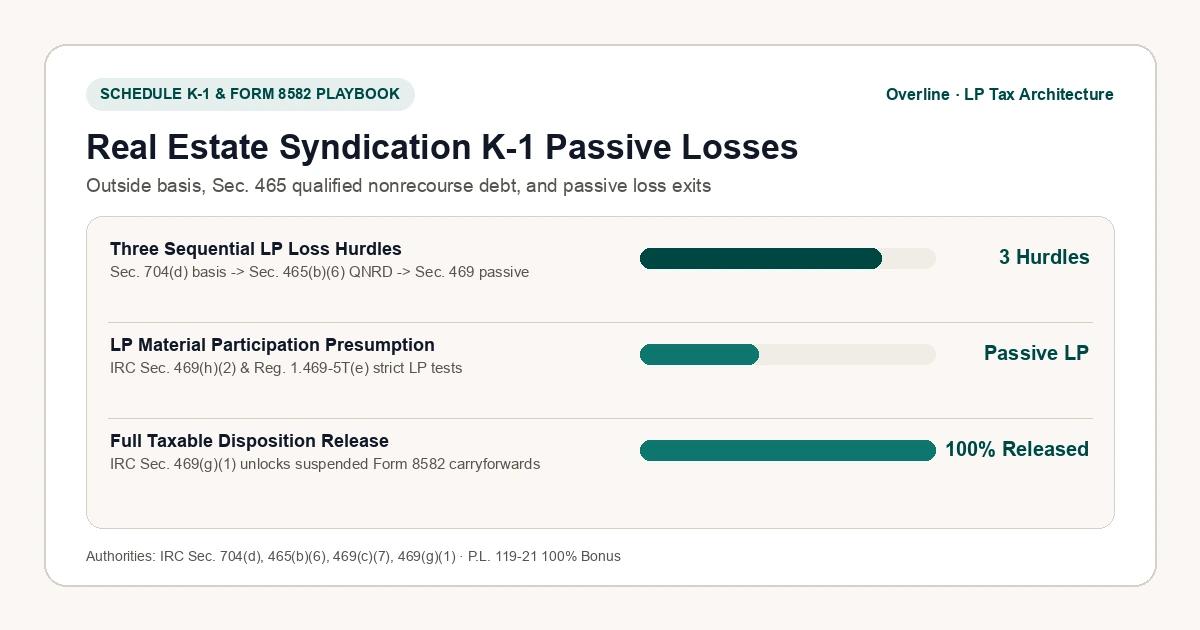
2026 Practitioner Quick Answer: When a syndication runs an engineering cost segregation study on property acquired after January 19, 2025, qualifying 5-year and 15-year components take
100%bonus depreciation under IRC Section 168(k) and P.L. 119-21 sec. 70301. A $100,000 Limited Partner (LP) check commonly receives a -$60,000 to -$90,000 Year-1 loss on Schedule K-1 (Form 1065), Box 2. Under IRC Section 469, LP losses sit inside the passive bucket on IRS Form 8582. They shelter passive rental income and passive sale gains from other deals, and carry forward indefinitely until a taxable sale under IRC Section 469(g)(1). Standalone LP K-1 losses cannot offset W-2 wages unless you qualify for Real Estate Professional Status (REPS) (track hours free), own direct rentals, and clear Treas. Reg. 1.469-9(g) and 1.469-9(f).
| Tax Dimension | Syndication LP (Schedule K-1 Box 2) | Direct Short-Term Rental (<= 7-Day Stay) | Direct Long-Term Rental with REPS |
|---|---|---|---|
| Governing Statute / Reg | IRC Sec. 469(c)(2) & Sec. 469(h)(2) | Treas. Reg. 1.469-1T(e)(3)(ii)(A) | IRC Sec. 469(c)(7) + Reg. 1.469-9(g) |
REPS Required (>750 hrs & >50% time)? | Yes, plus active direct rentals to group | No (excluded from "rental activity") | Yes (one spouse must pass both prongs) |
| Material Participation Test | Restricted LP rules (Reg. 1.469-5T(e) & 1.469-9(f)) | More than 100 hrs (& >= anyone else) or more than 500 hrs | All 7 tests (Reg. 1.469-5T(a)) if zero LP taint |
| Offsets W-2 Income in Year 1? | Almost never standalone | Yes, capped at $256K single / $512K MFJ in 2026 (Sec. 461(l)) | Yes, capped at $256K single / $512K MFJ in 2026 (Sec. 461(l)) |
$25,000 Active Allowance (Sec. 469(i))? | Statutorily barred (IRC Sec. 469(i)(6)(C)) | Inapplicable (non-rental trade/business) | Allowed for direct owners under $150K MAGI |
1. How a $100K LP Check Generates an $80K Schedule K-1 Loss
First-time syndication investors are often surprised when a $100,000 apartment LP check pays $6,500 in cash distributions while Schedule K-1 (Form 1065), Box 2 reports a -$80,000 tax loss. Two partnership basis rules make that leveraged deduction possible before passive rules ever apply.
First, Outside Basis under IRC Section 704(d) and Section 752 credits each partner with their cash contribution plus their share of partnership mortgage debt in Part II, Item K1. In a 65% loan-to-value syndication, a $100,000 equity check controls roughly $285,000 of leveraged real estate basis. Second, At-Risk Basis under IRC Section 465 normally blocks nonrecourse debt deductions, except IRC Section 465(b)(6) carves out Qualified Nonrecourse Financing from banks, agency lenders, or life companies. Because institutional senior real estate debt satisfies Section 465(b)(6), the LP clears both Form 6198 at-risk limits and outside basis limits.
In Modern CFO Cost Segregation Planning Benchmarks (v2026.1.0, CC BY 4.0), garden and mid-rise multifamily acquisitions reclassify 22% to 34% of depreciable building cost into 5-year and 15-year MACRS buckets. When the sponsor acquires and places the property in service after January 19, 2025, those reclassified buckets take 100% bonus depreciation in 2025 and 2026 under IRC Section 168(k) and Public Law 119-21 Section 70301. Syndications that signed a written binding purchase contract before January 20, 2025 and placed property in service in 2025 sit on the 40% phase-down branch instead.
Meanwhile, your $6,500 quarterly cash distributions appear in Schedule K-1, Box 19 (Code A). Under IRC Section 731(a)(1), cash distributions are a tax-free return of outside basis until basis hits $0, while the -$80,000 Box 2 loss moves to IRS Form 8582.
2. IRC Section 469, Form 8582 Carryforwards & "Lazy 1031" Laddering
At the third hurdle, IRC Section 469 Passive Activity Rules classify rental real estate as passive by default under IRC Section 469(c)(2). Furthermore, IRC Section 469(i)(6)(C) bars limited partners from claiming the $25,000 "active participation" rental allowance available to small direct landlords under $150,000 MAGI.
If you have no other passive income in Year 1, your -$80,000 Box 2 loss is suspended on IRS Form 8582 and carries forward indefinitely under IRC Section 469(b). Suspended LP passive losses unlock tax savings through three distinct channels.
- Future Box 2 operating profits from that syndication or any other passive rental or passive business K-1 are absorbed dollar for dollar before federal tax applies.
- Under Treas. Reg. 1.469-2T(c)(2)(i)(A), capital gains and Box 10 Net Section 1231 gains from selling another passive syndication count as passive activity gross income on Form 8582. Seasoned LPs use "Lazy 1031" K-1 laddering by investing in Deal B during the same year Deal A sells. Deal B's fresh Year-1 Box 2 cost segregation loss shelters Deal A's $140,000 Box 10 exit gain without a formal Section 1031 exchange.
- Under IRC Section 469(g)(1)(A), selling a syndication's property in a fully taxable disposition of your entire interest to an unrelated buyer unlocks 100% of remaining Form 8582 carryforwards. Those unlocked losses offset the deal's sale gain first, other passive income second, and your W-2 salary or portfolio income third.
3. Why LP K-1s Rarely Offset W-2 Income: REPS, Grouping & The 1.469-9(f) Trap
High-income W-2 physicians, executives, and engineers often ask whether investing in passive apartment syndications lets them deduct Box 2 losses against W-2 wages. Standalone LP investments cannot clear that bar because reading offering memorandums, reviewing quarterly K-1s, or voting on capital events are excluded investor hours under Treas. Reg. 1.469-5T(f)(2)(ii).
To pull an LP K-1 Box 2 loss into your non-passive bucket against W-2 income, you or your spouse must clear four consecutive statutory hurdles.
| Sequential Hurdle | Statutory Requirement | Where Standalone LPs Get Blocked |
|---|---|---|
| 1. REPS Qualification | More than 750 hours AND more than 50% of all working personal-service time in real property trades or businesses (IRC Sec. 469(c)(7)(B)) | Full-time W-2 employees almost never exceed 50% of total working hours in real estate unless a non-W-2 spouse qualifies. |
2. Direct Rental Portfolio + 1.469-9(g) Election | Attach formal written election under Treas. Reg. 1.469-9(g) treating all rental real estate interests as one combined activity | Without active direct rentals generating operational hours, grouping passive LP K-1s together still equals 0 operational hours. |
3. Limited Partner Taint (1.469-9(f) & 1.469-5T(e)) | Under IRC Sec. 469(h)(2) & Reg. 1.469-5T(e)(2), LP interests only pass material participation via more than 500 hours (or 5-of-10 prior years) | Under Reg. 1.469-9(f)(1), grouping even one LP K-1 taints the entire rental group as an LP interest unless LP gross rental share is under 10% of total rental gross income (1.469-9(f)(2)). |
4. 2026 Excess Business Loss Cap (IRC Sec. 461(l)) | Caps net non-passive business losses against W-2 wages at $256,000 single / $512,000 married filing jointly for 2026 (Rev. Proc. 2025-32 sec. 4.31) | Any non-passive deduction above $256K / $512K converts into a Section 172 NOL carryforward into Year 2 (subject to the 80% taxable income rule). |
Compare that four-part wall with owning a direct Short-Term Rental (STR). When average guest stays are 7 days or fewer under Treas. Reg. 1.469-1T(e)(3)(ii)(A), the property is excluded from "rental activity" and bypasses the REPS 750-hour test. A W-2 earner who logs more than 100 hours and more than anyone else (Treas. Reg. 1.469-5T(a)(3)), or more than 500 hours (1.469-5T(a)(1)), unlocks non-passive deductions. In 2026, those deductions offset W-2 wages up to $256,000 single / $512,000 joint under Section 461(l) (see full multi-year EBL math).
Try the REPS Hour Tracker
Tell the AI what you worked on, and it logs your hours, checks against IRS guidelines, and tracks your progress.

Free REPS tracker, audit-ready hour logs, and IRS-aligned activity verification.
Backed by $1B+ in supported tax depreciation.
4. Exit Taxation: IRC 1245 Recapture, Unrecaptured 1250 Gain & 3.8% NIIT
When a syndication sells in Year 5 without a partnership-level Section 1031 exchange, your final Schedule K-1 splits exit gains across three federal tax layers.
- IRC Section 1245 Ordinary Recapture (Schedule K-1 Box 11 / Form 4797 Part III): Prior depreciation on 5-year personal property and certain 15-year assets is recaptured up to realized gain and taxed at ordinary federal rates up to 37%. Sponsors allocate low exit residual value to aged 5-year interiors based on depreciated condition, though aggressive $0 allocations invite IRS scrutiny.
- Unrecaptured Section 1250 Gain (Schedule K-1 Box 9c): Prior straight-line building depreciation is taxed as capital gain subject to a statutory maximum federal rate ceiling of 25% under IRC Section 1(h)(1)(E).
- Net Section 1231 Long-Term Appreciation (Schedule K-1 Box 10): Appreciation above original cost is taxed at 15% or 20% capital gains ceilings. Passive LPs over $200,000 single / $250,000 joint MAGI also owe the 3.8% NIIT under IRC Section 1411, though unlocked Form 8582 losses offset these gains under IRC Section 469(g)(1).
Frequently Asked Questions: Real Estate Syndication K-1s & Passive Losses
Q: Why did I receive cash distributions in Box 19 while my Schedule K-1 Box 2 shows a huge tax loss?
A: Box 2 reflects taxable rental income after non-cash bonus depreciation, while Box 19 tracks cash paid out. Under IRC Section 731(a)(1), cash distributions reduce your outside partnership basis tax-free (down to $0) instead of counting as taxable income.
Q: Do unused Schedule K-1 passive losses expire if I have no passive income this year? A: No. Under IRC Section 469(b), disallowed passive losses carry forward indefinitely on IRS Form 8582 until absorbed by passive rental income or passive syndication gains. Any remaining carryforwards unlock in full upon a taxable sale of your entire interest under IRC Section 469(g)(1).
Q: Can a W-2 earner use syndication LP passive losses to offset W-2 salary without REPS? A: Generally no during the hold period, because IRC Section 469(c)(2) classifies rentals as passive and IRC Section 469(i)(6)(C) bars LPs from the $25,000 allowance. Only a qualifying Real Estate Professional (or spouse) making a Treas. Reg. 1.469-9(g) grouping election with active direct rentals can unlock grouped losses, capped at $256,000 single / $512,000 joint in 2026.
Q: Can a new syndication's Year-1 K-1 bonus depreciation offset the capital gain from another syndication that sold? A: Yes. Under Treas. Reg. 1.469-2T(c)(2)(i)(A), gain from selling passive rental property (such as Box 10 Net Section 1231 gain) enters Form 8582 as passive gross income. Current-year or suspended Box 2 passive losses from a second syndication can shelter that exit gain in the same tax year.
Related Overline Tools & Tax Guides
- Free REPS & STR Material Participation Hours Tracker
- Interactive Cost Segregation & Tax Savings Calculator
- Passive Loss Playbook: Suspended Deductions Strategy
- How the 2026 $512K Excess Business Loss Cap Hits Cost Segregation
- Real Estate Professional Status (REPS) Complete Guide
Disclaimer: This article is for informational and educational purposes only and does not constitute tax, legal, or investment advice. Consult your CPA regarding your Schedule K-1, Form 8582, Form 6198, and Treas. Reg. 1.469-9(g) elections.