

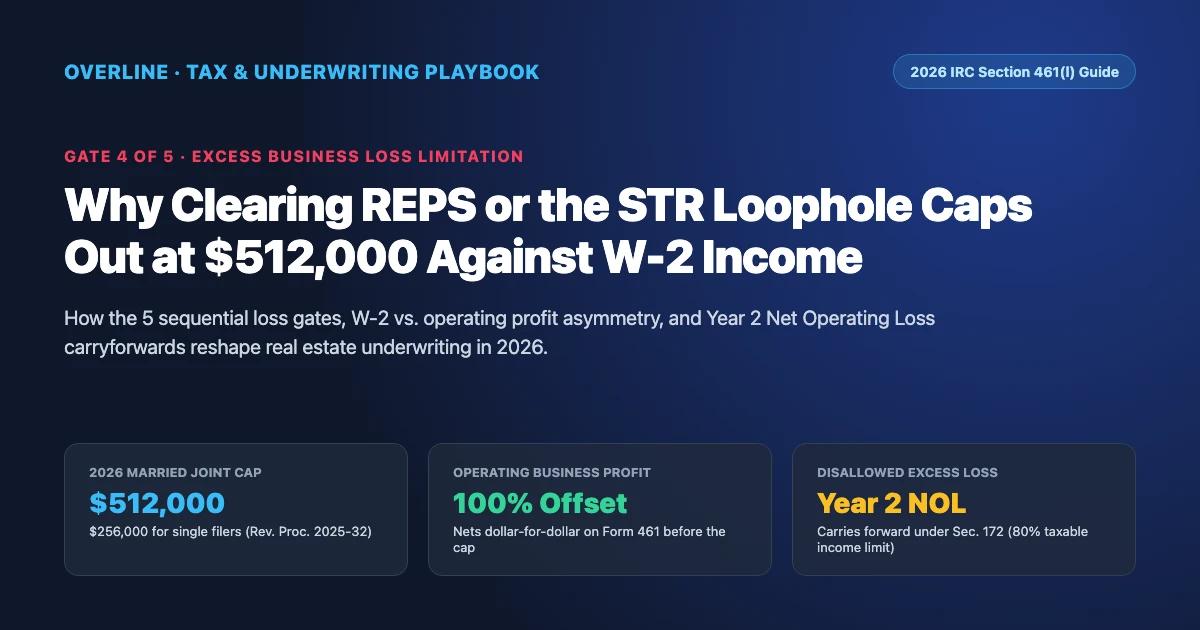
Why Clearing REPS or the STR Exception Does Not Mean Unlimited Year 1 W-2 Tax Savings
When high-income investors underwrite a real estate acquisition with 100% bonus depreciation (permanent for eligible property acquired and placed in service after January 19, 2025 under the One Big Beautiful Bill Act, P.L. 119-21), their pro forma often makes one critical assumption: once the investor qualifies for Real Estate Professional Status (REPS) plus material participation or the short-term rental (STR) exception, 100% of the Year 1 cost segregation paper loss will offset their W-2 paycheck immediately.
For net business losses under $250,000, that assumption holds. For larger acquisitions, multi-property portfolios, or high-basis short-term rentals, non-passive losses seeking to offset W-2 or non-business income hit Gate 4: the Excess Business Loss limitation under IRC Section 461(l).
For tax years beginning in 2026, Rev. Proc. 2025-32 (Section 4.31) sets the inflation-adjusted Excess Business Loss threshold at:
- $256,000 for single filers
- $512,000 for married couples filing jointly
If your net non-passive trade or business loss exceeds those thresholds and your primary income is W-2 wages or non-business portfolio income, the excess cannot be deducted in Year 1. Instead, under IRC Section 461(l)(2), it converts into a Net Operating Loss (NOL) carryforward to Year 2 under IRC Section 172.
Here is how investors and family offices model all five statutory loss gates in their acquisition underwriting.
The 5-Gate Underwriting Filter for Real Estate Tax Losses
A cost segregation loss seeking to offset non-passive, non-business income (such as W-2 wages) and carry any excess into Year 2 is tested across five sequential Internal Revenue Code rules:
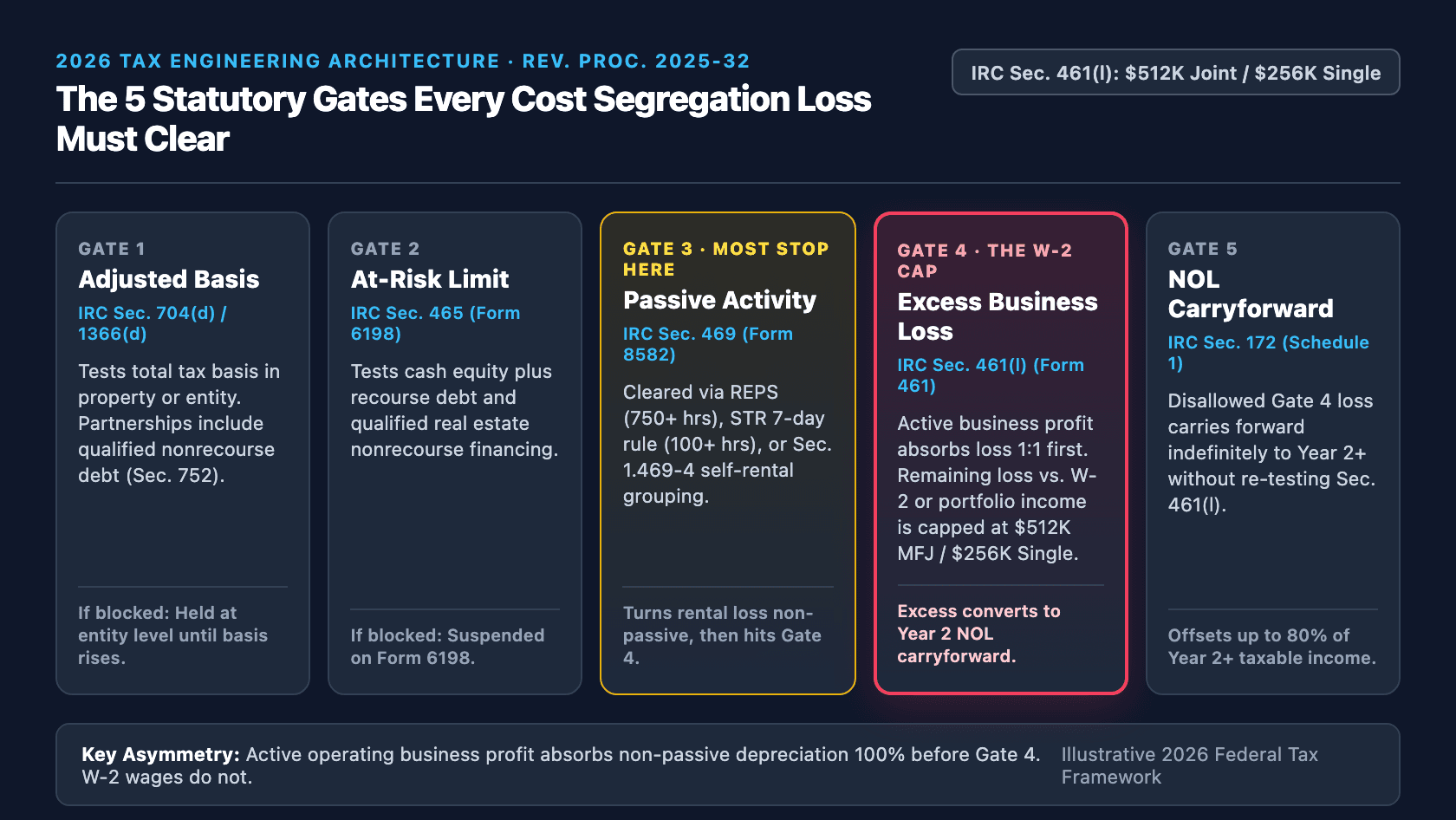
| Gate | Statutory Authority | What It Tests | Impact on Acquisition Pro Forma |
|---|---|---|---|
| Gate 1: Basis | IRC Section 704(d) / 1366(d) / 167(c) | Direct cost basis, partner outside basis (including allocable partnership nonrecourse debt under Section 752), or S-Corp shareholder stock plus direct shareholder loan basis. | Losses above basis are suspended at the partner or shareholder level. S-Corp shareholders do not get basis from entity-level bank loans. |
| Gate 2: At-Risk | IRC Section 465 | Cash equity plus recourse debt and qualified nonrecourse real estate financing under Section 465(b)(6) (Form 6198). | Seller-financed or related-party notes that do not meet Section 465(b)(6) qualified nonrecourse rules can suspend losses under Section 465. |
| Gate 3: Passive Activity | IRC Section 469 | Whether a loss exceeding passive income is non-passive via REPS (Section 469(c)(7) more than 750 hours and more than 50% of personal services in real property trades or businesses in which the taxpayer materially participates, plus material participation in each rental activity or in the combined rental activity after a valid Reg. 1.469-9(g) aggregation election), the STR exception (Treas. Reg. 1.469-1T(e)(3)(ii)(A) average customer use of 7 days or less plus material participation, such as more than 100 hours and not less than any other individual under Reg. 1.469-5T(a)(3)), or valid self-rental grouping (Treas. Reg. 1.469-4(c) and 1.469-4(d)(1)(i)). | If passive and no passive income exists, losses are suspended on Form 8582 until future passive income or a qualifying taxable disposition under Section 469(g). |
| Gate 4: Excess Business Loss | IRC Section 461(l) | Caps net aggregate trade or business deductions (for rental activities rising to a trade or business) over aggregate trade or business gross income/gains at $256,000 single / $512,000 married filing jointly in 2026 (Form 461). | Active trade or business income absorbs losses dollar for dollar first. W-2 wages (excluded under Section 461(l)(3)) only absorb up to the $256K / $512K cap in Year 1. |
| Gate 5: Net Operating Loss | IRC Section 172(a)(2) | Governs any loss disallowed at Gate 4 when carried forward to Year 2+. | Converts into an NOL that offsets up to 80% of modified taxable income (computed without NOL, Section 199A, and Section 250 deductions) in Year 2+ without being re-tested against the Section 461(l) cap. |
For the complete engineering and line-by-line Form 461 mechanics behind these five gates, see FreeCostSeg's technical guide to the IRC Section 461(l) Excess Business Loss cap.
The Income-Source Asymmetry: W-2 Executive vs. Operating Business Owner
Why do two investors buying the exact same $3.5 million commercial or short-term rental property get different Year 1 cash tax outcomes? Because Form 461 treats active operating business profit and W-2 wages differently.
Under IRC Section 461(l)(3)(A), all non-passive trade or business deductions and gross income/gains are netted together first (with business capital gains and losses subject to the limitation in IRC Section 461(l)(3)(C), and the inflation-adjusted threshold amount determined under Section 461(l)(3)(A)(ii)(II)). Only the net aggregate business loss remaining after that netting is tested against the 2026 $512,000 married ($256,000 single) cap. Under IRC Section 461(l)(3)(A) flush language and Section 461(l)(3)(B), performing services as an employee (W-2 wages) is excluded from trade or business income, and non-business portfolio income (interest, dividends, non-business capital gains) is likewise excluded.
Worked Comparison: $1,000,000 Income + $1,000,000 Non-Passive Cost Seg Loss (2026 MFJ)
The table and chart below illustrate a simplified constant-rate (37% top marginal rate) comparison assuming no other income, adjustments, or deductions:
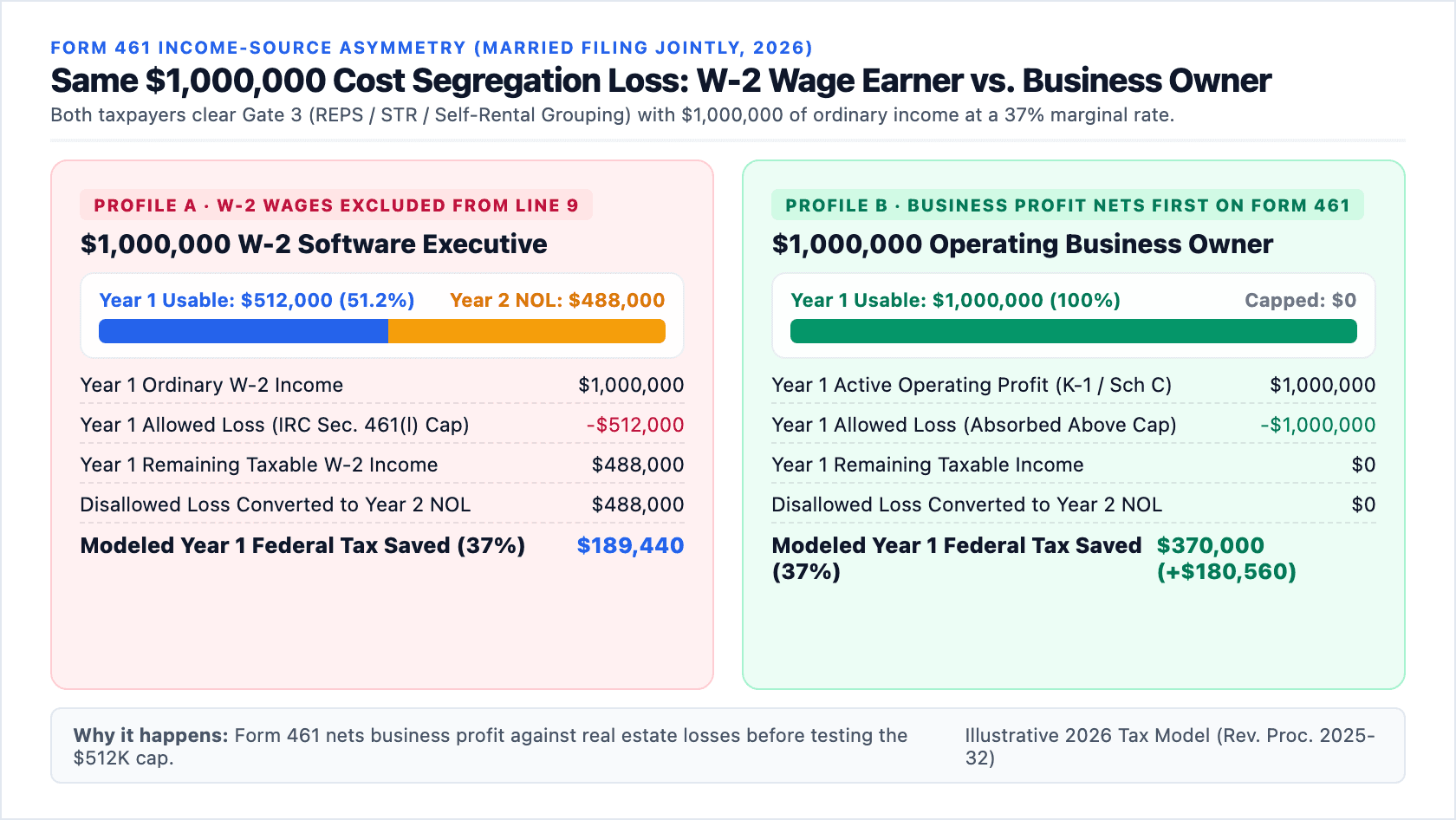
| Illustrative Underwriting Line Item | Investor A: W-2 Tech Executive ($1M Salary) | Investor B: Operating Business Owner ($1M Active S-Corp / Partnership Profit) |
|---|---|---|
| 2026 Gross Income | $1,000,000 (W-2 Wages) | $1,000,000 (Active Business K-1) |
| Year 1 Non-Passive Cost Seg Loss | ($1,000,000) | ($1,000,000) |
| Absorbed by Business Income on Form 461 | $0 | $1,000,000 |
| Net Business Loss Subject to Section 461(l) | ($1,000,000) | $0 |
| Year 1 Allowed Tax Deduction | $512,000 (Capped) | $1,000,000 (Uncapped) |
| Illustrative Year 1 Tax Reduction (at Flat 37%) | $189,440 | $370,000 |
| Carried Forward to 2027 as Section 172 NOL | $488,000 | $0 |
| Illustrative Year 2 Tax Reduction via NOL (80% Cap, Flat 37%) | $180,560 | $0 |
| Illustrative Cumulative 2-Year Tax Reduction (Flat 37%) | $370,000 | $370,000 |
Three Underwriting Takeaways From This Table
- Operating business owners have no Year 1 Section 461(l) cap up to their active business profit: If you materially participate in a profitable HVAC company, medical practice, construction firm, or agency generating $1,000,000 in active pass-through profit, your business profit absorbs a $1,000,000 non-passive real estate loss before the $512,000 cap is tested. (For owners purchasing their own commercial headquarters, warehouse, or yard, see Level CFO's guide to owner-occupied cost segregation and Treas. Reg. 1.469-4 grouping.)
- A capped loss for a W-2 earner is delayed, not permanently disallowed: Under the simplified flat 37% illustration above, Investor A still captures the full $1,000,000 deduction across Year 1 ($512,000) and Year 2 ($488,000) because the $488,000 excess converts into a Section 172 NOL carryforward. Assuming $1,000,000 of modified taxable income before the NOL in Year 2, the 80% NOL limit ($800,000 ceiling) absorbs the entire $488,000 carryforward without re-testing Section 461(l). (Actual dollar tax savings depend on progressive bracket thresholds, other deductions, and state tax conformity.)
- What happens on a $2,000,000 loss for a $1,000,000 W-2 earner: If Investor A generates a $2,000,000 non-passive cost segregation loss in 2026, they deduct $512,000 in Year 1 and carry forward a $1,488,000 NOL. In Year 2 (assuming $1,000,000 of modified taxable income before the NOL), the 80% NOL rule allows an $800,000 deduction, leaving $200,000 of taxable income in Year 2 and carrying the remaining $688,000 NOL into Year 3.
How to Structure Acquisitions Around the $512,000 Cap
If you are a high-income W-2 earner acquiring multiple properties or a single $2M+ asset, you can coordinate three planning controls with your CPA:
- Elect out of bonus depreciation by MACRS class (IRC Section 168(k)(7)): Because 100% bonus depreciation applies by default to eligible property acquired and placed in service after January 19, 2025, a taxpayer can make a timely affirmative election under Section 168(k)(7) out of bonus depreciation for all property in a specific MACRS recovery class placed in service during that tax year (for example, keeping 100% bonus on the 5-year class while electing out for the 15-year class).
- Stagger placed-in-service readiness across tax years: A property is placed in service when it is ready and available for its specifically assigned rental function. Placing one STR in service in late 2026 and completing readiness to place a second STR in service in early 2027 utilizes two separate annual Section 461(l) caps (the $512,000 joint cap in 2026 plus the separately inflation-adjusted 2027 cap).
- Stage look-back studies with Form 3115: If a property has been depreciated over a 27.5-year or 39-year recovery period without a cost segregation study and has established an accounting method, your CPA can evaluate an eligible automatic accounting-method change on Form 3115 in a future tax year to correct an impermissible recovery period for qualifying 5-year and 15-year components and claim an eligible net Section 481(a) catch-up adjustment (subject to applicable automatic-change procedures and original placed-in-service year bonus rules; note that an automatic Form 3115 corrects an impermissible depreciation method and cannot generally be used to reverse a valid Section 168(k)(7) bonus depreciation opt-out election or another valid depreciation election).
Want to see whether your next property's Year 1 accelerated depreciation will clear or exceed the $256,000 single / $512,000 joint threshold? Run our free cost segregation calculator to model your 5-year, 15-year, and bonus depreciation split.
Frequently Asked Questions (2026 IRC Section 461(l) Cap)
Q: What is the Excess Business Loss cap for cost segregation in 2026?
A: Under IRC Section 461(l), as adjusted for inflation by Rev. Proc. 2025-32 (Section 4.31), the 2026 Excess Business Loss threshold is $256,000 for single filers and $512,000 for married couples filing jointly. Net non-passive trade or business losses above that amount cannot offset W-2 wages or non-business income in Year 1 and instead convert into a Net Operating Loss (NOL) carryforward under IRC Section 461(l)(2) and Section 172.
Q: Does qualifying for REPS or the short-term rental exception bypass the $512,000 cap?
A: No. Qualifying for Real Estate Professional Status (IRC Section 469(c)(7)) with material participation in each rental activity (or in the combined rental activity after a valid Treas. Reg. 1.469-9(g) aggregation election), or satisfying the short-term rental exception (Treas. Reg. 1.469-1T(e)(3)(ii)(A) average customer use of 7 days or less plus material participation), only clears Gate 3, the Passive Activity Loss rules. Once a trade-or-business rental loss is non-passive, it is tested at Gate 4 on Form 461 before it can offset W-2 wages or non-business income.
Q: Why can an operating business owner deduct a $1,000,000 cost segregation loss in Year 1 while a W-2 earner is capped at $512,000?
A: Form 461 nets aggregate trade or business deductions against aggregate trade or business gross income and gains before applying the $512,000 married ($256,000 single) cap. Active S-corporation, partnership, or Schedule C operating profits absorb non-passive cost segregation losses dollar for dollar first, whereas W-2 wages are excluded from trade or business income under IRC Section 461(l)(3)(A) flush language and Section 461(l)(3)(B).
Q: What happens to a cost segregation loss that exceeds the 2026 Section 461(l) threshold?
A: Under IRC Section 461(l)(2), the disallowed excess loss is not permanently lost. It converts into a Net Operating Loss (NOL) carryforward into Year 2 under IRC Section 172, where under Section 172(a)(2) it can offset up to 80% of modified taxable income (computed without regard to the NOL, Section 199A, and Section 250 deductions) without being re-tested against the Section 461(l) cap.
See Your Property's Tax Savings
Drop your address. The AI estimates your depreciation savings in 60 seconds, backed by a certified engineer study.

Free cost segregation estimate, engineer-certified studies, and ongoing depreciation tracking.
Backed by $1B+ in supported tax depreciation.
Disclaimer: This article is for informational and educational purposes only and does not constitute tax, legal, or accounting advice. Always consult your CPA or tax advisor regarding your specific income, filing status, and Form 461 / Form 8582 elections.