

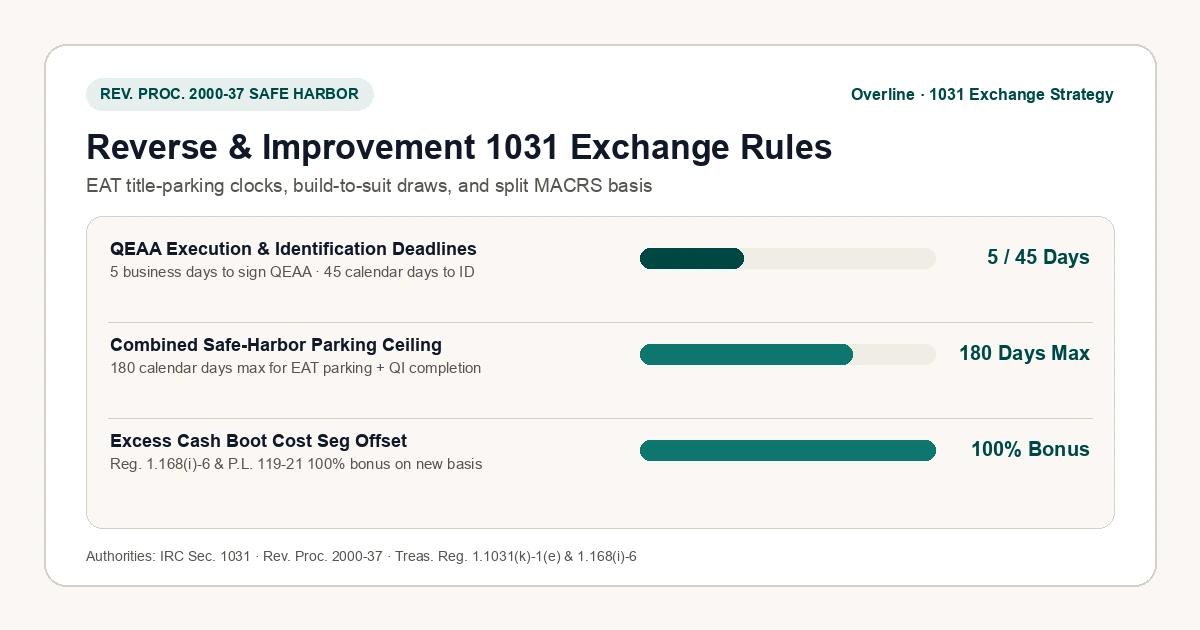
2026 Practitioner Quick Answer: Under IRS Revenue Procedure 2000-37, you can buy replacement property before selling your old property in a Reverse 1031 Exchange. You can also deploy exchange equity to renovate or build before taking title in an Improvement / Build-to-Suit 1031 Exchange via an Exchange Accommodation Titleholder (EAT). You must sign the QEAA within 5 business days, identify the relinquished property or build specs within 45 calendar days, and finish within 180 calendar days. Uninstalled materials on-site on Day 180 or prepaid post-transfer labor trigger taxable boot under Treas. Reg. 1.1031(k)-1(e). Under Treas. Reg. 1.168(i)-6, trade-up Excess Basis acquired and placed in service after January 19, 2025 takes 100% bonus depreciation via cost segregation.
| 1031 Exchange Structure | Governing IRS Authority | Who Holds Title During Window | Key Deadlines (5 / 45 / 180) | Primary Tax Trap |
|---|---|---|---|---|
| Standard Forward 1031 | IRC Sec. 1031(a) & Reg. 1.1031(k)-1 | Qualified Intermediary (QI) holds cash only | 45 days ID replacement; 180 days close | Missing Day 45 ID collapses 100% of deferral |
| Reverse 1031 (Exchange Last) | Rev. Proc. 2000-37 & Rev. Proc. 2004-51 | EAT LLC parks replacement property | 5 bus. days QEAA; 45 days ID old property; 180 days sell & close | Fails if taxpayer owned property within prior 180 days (Rev. Proc. 2004-51) |
| Improvement / Build-to-Suit 1031 | Reg. 1.1031(k)-1(e) + Rev. Proc. 2000-37 | EAT LLC holds title while contractor builds | 45 days ID land + specs; 180 days affix & convey deed | Unaffixed materials on ground or prepaid post-Day-180 labor = taxable boot |
1. Reverse 1031 Safe Harbor: Rev. Proc. 2000-37 & The 5 / 45 / 180 Clock
In competitive commercial and multifamily markets, sellers rarely wait for you to list and close your current building first. Yet you cannot simply take title to the new building in your own LLC today and sell your old building three months later: holding record title to both assets simultaneously disqualifies the transaction as a reciprocal exchange under IRC Section 1031(a)(1).
To solve that sequencing problem, IRS Revenue Procedure 2000-37 (Section 4.02) created the Qualified Exchange Accommodation Arrangement (QEAA) safe harbor. Instead of deeding the new property to you at closing, an independent Exchange Accommodation Titleholder (EAT) single-member LLC steps in to acquire and "park" legal title. Under Rev. Proc. 2000-37 Section 4.03, you may loan purchase cash to the EAT, guarantee the EAT's bank loan, and lease or manage the parked property.
Every safe-harbor Reverse 1031 must hit three rigid statutory deadlines with zero extensions absent a federal disaster notice under Rev. Proc. 2018-58.
| Milestone | Exact Deadline | Rev. Proc. 2000-37 Citation & Mandatory Action |
|---|---|---|
| 1. Sign Written QEAA | Within 5 business days after EAT takes title | Sec. 4.02(3): Execute formal QEAA agreement stating EAT holds qualified indicia of ownership as beneficial federal tax owner under Rev. Proc. 2000-37. |
| 2. Identify Relinquished Asset | Within 45 calendar days after EAT takes title | Sec. 4.02(4): Deliver signed written identification of the relinquished property you will sell (using the 3-property, 200%, or 95% rules of Reg. 1.1031(k)-1(c)(4)). |
| 3. Close Sale & Unpark Deed | Within 180 calendar days after EAT takes title | Sec. 4.02(5) & (6): Sell the relinquished property through the QI and transfer the parked replacement property from the EAT to the taxpayer; combined QEAA parking cannot exceed 180 calendar days. |
Watch the 180-day prior-ownership ban. In DeCleene v. Commissioner, 115 T.C. 457 (2000), the Tax Court rejected deeding investor-owned land to an accommodator just to build improvements and exchange it back. Following DeCleene, IRS Revenue Procedure 2004-51 barred QEAA safe-harbor treatment whenever the taxpayer owned the parked property within the 180-day period before EAT transfer.
2. Improvement (Build-to-Suit) 1031 Exchanges & The Day-180 Boot Trap
Suppose your relinquished building sells for $1,500,000, and the best replacement asset is a $950,000 shell needing $550,000 of heavy renovations. Closing on the $950,000 property directly on Day 60 makes any subsequent construction improvements to land you already own. Those post-closing improvements cannot absorb your remaining $550,000 of exchange proceeds, triggering $550,000 of taxable boot under IRC Section 1031(b).
In an Improvement (Build-to-Suit) 1031 Exchange under Treas. Reg. 1.1031(k)-1(e) and Rev. Proc. 2000-37, the EAT holds title while exchange funds pay approved construction draws before Day 180. Two strict execution rules separate clean deferral from an unexpected tax bill.
- Your 45-day identification notice (
Treas. Reg. 1.1031(k)-1(e)(2)(i)) must identify both the legal description of the land and as much construction detail as practicable (plans or line-item specs). - Under Treas. Reg. 1.1031(k)-1(e)(3)(i) and (iii), only improvements completed and permanently affixed as real property under Treas. Reg. 1.1031(a)-3 upon EAT deed transfer (by Day 180) count as like-kind value. Uninstalled lumber, boxed cabinetry, or unmounted HVAC condensers sitting on the ground on Day 180 are personal chattel. Prepaying a general contractor for post-Day-180 labor buys services, triggering immediate taxable boot dollar for dollar.
3. Carryover vs. Excess Basis: Cost Segregation After a 1031 Exchange
When your Reverse or Improvement 1031 Exchange closes, IRC Section 168(i)(7) and Treas. Reg. 1.168(i)-6 split replacement tax basis into two MACRS buckets.
- Exchanged (Carryover) Basis (
Treas. Reg. 1.168(i)-6(c)): Your old adjusted basis carried forward from the relinquished property. Under the step-in-the-shoes schedule, Exchanged Basis continues depreciating over your old recovery clock and does not take new Section 168(k) bonus depreciation (Treas. Reg. 1.168(k)-2(g)(5)). - Excess Basis (
Treas. Reg. 1.168(i)-6(d)(1)): Every dollar of trade-up capital added above your relinquished net sale price through fresh cash paid in or increased mortgage debt. Excess Basis is treated as newly acquired, newly placed-in-service property.
Suppose you sell a rental for $1,200,000 with $550,000 adjusted basis and complete a Reverse 1031 into a $2,050,000 multifamily property acquired after January 19, 2025.
| Replacement Basis Bucket | Calculation | Depreciable Building Share (Assumes 80% Building / 20% Land) | Year-1 Cost Seg Treatment (Post-Jan 19, 2025 Acquisition) |
|---|---|---|---|
| Exchanged (Carryover) Basis | Old adjusted basis carried over = $550,000 | Continues prior remaining MACRS schedule | Ineligible for new bonus; continues step-in-the-shoes recovery (or fresh clock if 1.168(i)-6(i)(1) election made) |
| Excess Basis (Trade-Up) | $2,050,000 - $1,200,000 = $850,000 | $680,000 new depreciable building basis | 28% reclassified ($190,400) into 5/15-yr property takes 100% Year-1 bonus depreciation |
Quick Year-1 Depreciation & Safe Harbor Estimator
Pick a preset or adjust 2 inputs to compare Year-1 deductions instantly.
In Modern CFO Cost Segregation Planning Benchmarks (v2026.1.0, CC BY 4.0), multifamily buildings reclassify 22% to 34% of building basis (and retail/industrial properties reclassify 15% to 32%). Because that $850,000 of Excess Basis is acquired and placed in service after January 19, 2025, an engineering cost segregation study unlocks 100% bonus depreciation in 2025 and 2026 under IRC Section 168(k) and Public Law 119-21 Section 70301. Replacement property acquired under a written binding contract signed before January 20, 2025 and placed in service in 2025 sits on the 40% phase-down branch instead. If you later remodel replacement systems, pair that work with a Partial Asset Disposition calculation under Treas. Reg. 1.168(i)-8.
4. The IRC 1245(b)(4) & 1250(d)(4) Cost Segregation Recapture Trap
Since the Tax Cuts and Jobs Act limited IRC Section 1031(a)(1) to real property, Treas. Reg. 1.1031(a)-3 confirmed good news for cost segregation users. Permanently affixed interior components and land improvements remain qualifying "real property" for Section 1031 even when depreciated over 5 or 15 years as Section 1245 assets. Movable non-affixed chattel such as standalone furniture does not qualify and triggers boot if bought with exchange funds.
However, IRC Section 1245(b)(4) and IRC Section 1250(d)(4) create a mismatch trap when trading a cost-segregated building into land-heavy replacement real estate. Even with $0 cash boot and higher debt, IRC Section 1245(b)(4) triggers ordinary-income recapture up to 37% when prior Section 1245 deductions exceed replacement Section 1245 real property acquired.
For example, selling a car wash or apartment carrying $320,000 of prior Section 1245 deductions into raw land or a NNN ground lease triggers $320,000 of immediate Form 4797 recapture. Always run a component screen during your 45-day identification window and maintain taxpayer continuity across your LLC holding structure.
Frequently Asked Questions: Reverse & Improvement 1031 Exchanges
Q: Can I buy my replacement property in my own LLC first and set up a Reverse 1031 Exchange a week later? A: No. Under Rev. Proc. 2000-37 and Rev. Proc. 2004-51, an independent Exchange Accommodation Titleholder (EAT) must acquire and hold title at closing, and the written QEAA must be signed within 5 business days. Once you take title directly, safe-harbor reverse exchange treatment is lost for 180 days.
Q: Do construction materials delivered to the job site before Day 180 count toward an Improvement 1031 Exchange? A: Only if they are permanently installed and affixed as real property before the EAT transfers title to you on or before Day 180. Under Treas. Reg. 1.1031(k)-1(e)(3), uninstalled materials sitting on the ground and prepaid post-transfer contractor labor are treated as non-like-kind boot taxable under IRC Section 1031(b).
Q: Can I use 1031 exchange funds to build an ADU or warehouse on land I already own? A: No. Under DeCleene v. Commissioner, 115 T.C. 457 (2000), and Rev. Proc. 2004-51, using exchange proceeds to construct improvements on land owned by the taxpayer (or owned within the prior 180 days) fails IRC Section 1031 because you cannot exchange into property you already own.
Q: Does the entire purchase price of a 1031 replacement property qualify for 100% bonus depreciation? A: No. Under Treas. Reg. 1.168(i)-6, only your Excess Basis (new cash plus net additional debt above the relinquished sale price) qualifies as newly acquired property. Excess Basis acquired and placed in service after January 19, 2025 takes 100% bonus depreciation, while Carryover Basis continues depreciating without new bonus depreciation.
Related Overline Tools & Tax Guides
- Cost Segregation & Excess Basis Tax Savings Calculator
- Partial Asset Disposition (PAD) Calculator
- Real Estate Entity & LLC Asset Protection
- 45-Day 1031 Replacement Property Cost Seg Evaluation
- Cost Segregation Exit Strategy & Recapture Analysis
See Your Property's Tax Savings
Drop your address. The AI estimates your depreciation savings in 60 seconds, backed by a certified engineer study.

Free cost segregation estimate, engineer-certified studies, and ongoing depreciation tracking.
Backed by $1B+ in supported tax depreciation.
Disclaimer: This article is for informational and educational purposes only and does not constitute tax or legal advice. Reverse and build-to-suit 1031 exchanges involve strict statutory deadlines; engage a Qualified Intermediary, real estate tax counsel, and CPA before signing purchase contracts.